
As I chart my course through the ever-evolving waters of Rare's pirate simulator, Sea of Thieves, in 2026, I'm witnessing a game that has transformed from its humble beginnings into a living, breathing world. Having launched in 2018 with a content pool as shallow as a tide pool, the game has since been redeemed by a relentless tide of seasonal updates, becoming a cornerstone of shared-world adventure. We, the players, are the authors here, crafting our own tales of plunder, skirmish, and camaraderie on the high seas. Yet, the life of a live-service game is like navigating by the stars—some constellations fade to make way for new ones. In a move that felt like scuttling a beloved but seldom-used ship, Rare officially decommissioned the dedicated PvP Arena mode back in March of 2022, a decision made to streamline the experience for the vast majority of us.
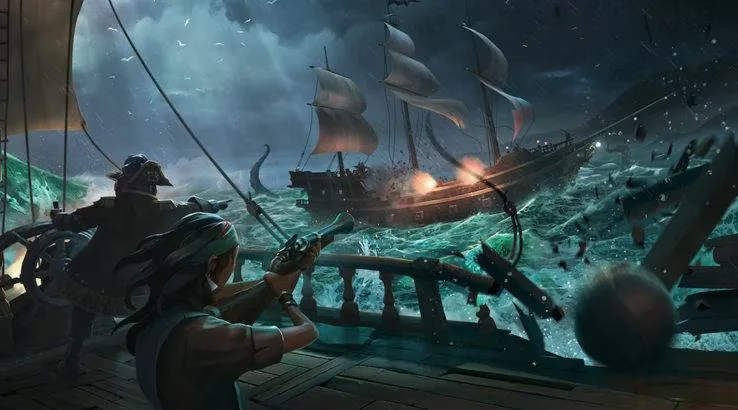
The Sunset of The Arena: A Niche Harbor Closes
The closure of The Arena was a bittersweet moment. For a small, dedicated cadre of pirates—amounting to only about 2% of total playtime—it was a sacred dueling ground, a coliseum of the waves where skill with cannon and cutlass reigned supreme. Its removal, coupled with other server optimizations, was akin to a cartographer removing a detailed but rarely visited island from the map to make the overall chart clearer. While it offered flexibility for pure PvP enthusiasts, Rare's difficult decision was a strategic retreat, allowing the studio to focus its resources on content with broader appeal. This left some achievements permanently locked in a sunken chest and made spontaneous ship-to-ship combat—already a delicate dance due to server caps—feel as rare as spotting a blue whale. For those who loved it, the Arena's final voyage was a poignant end to an era of structured naval warfare.
The Ever-Expanding Ocean: A Service That Keeps Sailing
Yet, to focus solely on what was lost is to ignore the vast ocean of content that has flooded in since. Sea of Thieves in 2026 is a testament to the "games as a service" model done right. The game has become a cultural touchstone, weaving in epic crossovers like Pirates of the Caribbean and introducing limited-time Adventures that feel like monthly serialized novels for our pirates. The recent years have seen a relentless focus on enriching the core sandbox:
-
Sea Forts: These became a staple, offering raid-like events accessible to solo sloopers and full galleon crews alike. Storming these stone fortresses to battle phantoms and claim loot is now a fundamental part of any pirate's career.
-
Ongoing "Adventures": These narrative-driven, time-limited events each arrived with cinematic flair, deepening the game's lore and giving our plundering purpose. They transformed the world from a static playground into a stage for an ongoing saga.
-
Quality of Life & Accessibility: Updates have continually polished the experience, from the charmingly practical (like the squeaking ship's wheel that acts as an audio cue) to major systemic improvements ensuring everyone can enjoy the voyage.
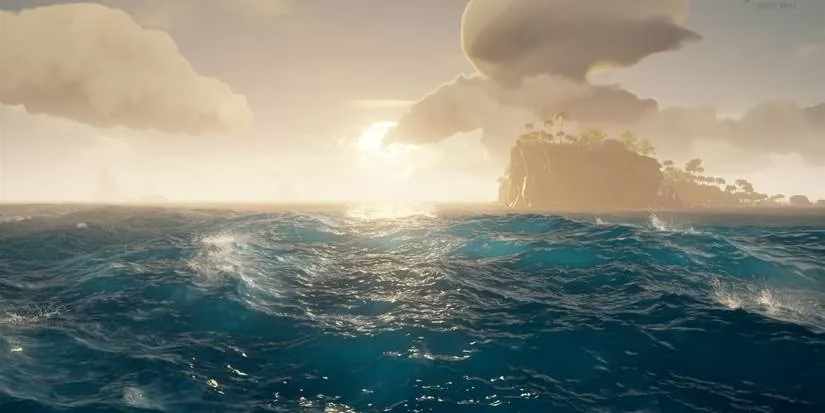
The Horizon in 2026: What's Next on the Chart?
Looking ahead from our vantage point in 2026, the philosophy remains clear: evolution through addition and refinement. The removal of The Arena was not an act of subtraction but of pruning, allowing healthier growth elsewhere. The current seasonal model feels less like a series of updates and more like a continuously unfurling scroll of new tales and trials. The core adventure—that unpredictable cocktail of voyage completion, emergent player encounters, and breathtaking seafaring—remains as potent as ever. New threats emerge from the fog, new treasures are buried on forgotten isles, and the promise of collaboration with other franchises still hangs on the horizon like a tantalizing mirage. The game's world is no longer just a setting; it's a character in its own right, one that grows and changes with each passing season.
In the end, my journey through Sea of Thieves has taught me that a live-service world is an ecosystem. Sometimes, a feature, like a specialized predator, must make way for the overall health of the environment. The Arena was that predator—elegant and fierce, but occupying a niche that few visited. Its departure allowed the wider jungle of adventure to grow more lush and inviting for all. As I raise my spyglass to the future, I see a game that has mastered the art of sailing forward, not by clinging to every piece of driftwood from its past, but by confidently catching the prevailing winds of player engagement and storytelling. The seas are troubled, mysterious, and endlessly inviting. More treasure, without a doubt, is always on the way.